
Data Science Day 2025
The Data Science Day 2025 brought together our community and offered engaging insights into recent Data Analysis Projects by our Master students in Business Analytics, Data Science, and Digital Humanities. The key moments of the event was the Poster Awards, which honoured outstanding contributions from our Master students.
We are pleased to announce the winners of the Poster Awards:
- Ariana FOX from Data Science
Comparison of Graph-Encoding Trees supervised by Nils Kriege and Franka Bause - Hannes ESSFORS from Digital Humanities
Sociophonetic variation in Afrikaans vowel production supervised by Andreas Baumann - Lukas Till SCHAWERDA from Data Science
Comparison of time-frequency representations for neural-network based keyword spotting supervised by Peter Balazs
All participating projects (in alphabetical order):
- A Deep Dive into Deep Knowledge Tracing by Botond Kovács from Data Science supervised by Sebastian Tschiatschek
- A Geospatial Analysis of Slavery: What data from the SlaveVoyages-database can tell us about the shift to the "second slavery" in the 19th century by André Novak from Digital Humanities supervised by Maria Vargha
- A Prototype for Reliable Travel Planning by Pavlina Madl, Merve Özgür and Gloria Widhalm from Business Analytics supervised by Jan Ehmke and Steffen Elting
- Density-Based Clustering in Semi-Metric Space for Large-Scale Data by Luiza Krzepkowska from Data Science supervised by Sebastian Ratzenböck
- Explainable mRNA Degradation Prediction by Felix Elias Krause and Miriam Sibitz from Data Science supervised by Sebastian Tschiatschek
- Future Weather Data Morphing for Building Simulation by Sophie Hamann from Digital Humanities supervised by Renato Rocha Souza
- Linguistic Accommodation in Corpora and Large Language Models by Agnieszka Gwizdek from Data Science as well as Antonio Innocenti and Susanne Sophie Schmalwieser from Digital Humanities supervised by Benjamin Roth
- Linguistic Diversity in the Digital Age: Exploring the Effect of Digital Literacy on Minority Languages by Katharina Zeh and Lale Tüver from Digital Humanities supervised by Andreas Baumann
- Literary History: Clustering & Geospatial Analysis in Hübner's 'Hamburgische Bibliotheca historica, der studierenden Jugend zum Besten zusammengetragen' by Robin Luger and Sarah Wirnsperger from Digital Humanities supervised by Thomas J. J. Wallnig
- Never Stranded – Backup Travel Planning by Paulina Heine, Diana Lutska and Denis Vorontsov from Business Analytics supervised by Jan Ehmke and Steffen Elting
- Orienteering Problem with Time Windows and Profits (OPTWP) - a Case Study for Vienna by Christian Orlowski from Business Analytics supervised by Jan Ehmke and Tom Bormann
- Sportsanalytics for Rowing Data by Predrag Dindic from Data Science supervised by Torsten Möller
- Stoppschild für die Chancengleichheit? Eine Analyse des Gender Bias in GPT-generierten Stellenausschreibungen by Shirin Yanni from Digital Humanities supervised by Arndt Niebisch
Our congratulations go to the winners of the Poster Awards, and sincere thanks to all participating students for their valuable contributions!
In addition to the Poster Session, the Data Science Day featured a diverse programme of presentations. It included a presentation by Women in AI Austria, a local non-profit organisation committed to reducing the gender gap in artificial intelligence by empowering women and promoting gender diversity across algorithm design and data practices. Entrepreneurship @ Uni Vienna contributed insights from the innovation labs, which support students and early-career researchers in developing entrepreneurial skills through an accelerated venture-creation process.
The programme concluded in with a keynote by Francesco Bonchi, who presented recent advances in distributional max-min fairness, demonstrating how randomisation can enhance individual fairness in algorithmic decision-making and its relevance across core computational problems such as matching, ranking, and shortest-path queries. Francesco Bonchi is the Co-Founder and Research Director of CENTAI in Turin and holds additional research and advisory roles across Europe, bringing extensive expertise at the intersection of artificial intelligence and society.
Finally, we would like to thank Entrepreneurship @ Uni Vienna for their support. Their contribution played an important role of making the event a success and helped strengthen the data science community. We look forward to continuing our collaboration in the future.
Review of our Data Science Day 2025

Welcome Address by Vice Rector and Board Member Nikolaus Hautsch

Welcome Address by Hosts Head of Department of Astrophysics Glenn van de Ven as well as Vice Head of Department of Astrophysics and Board Member Oliver Hahn
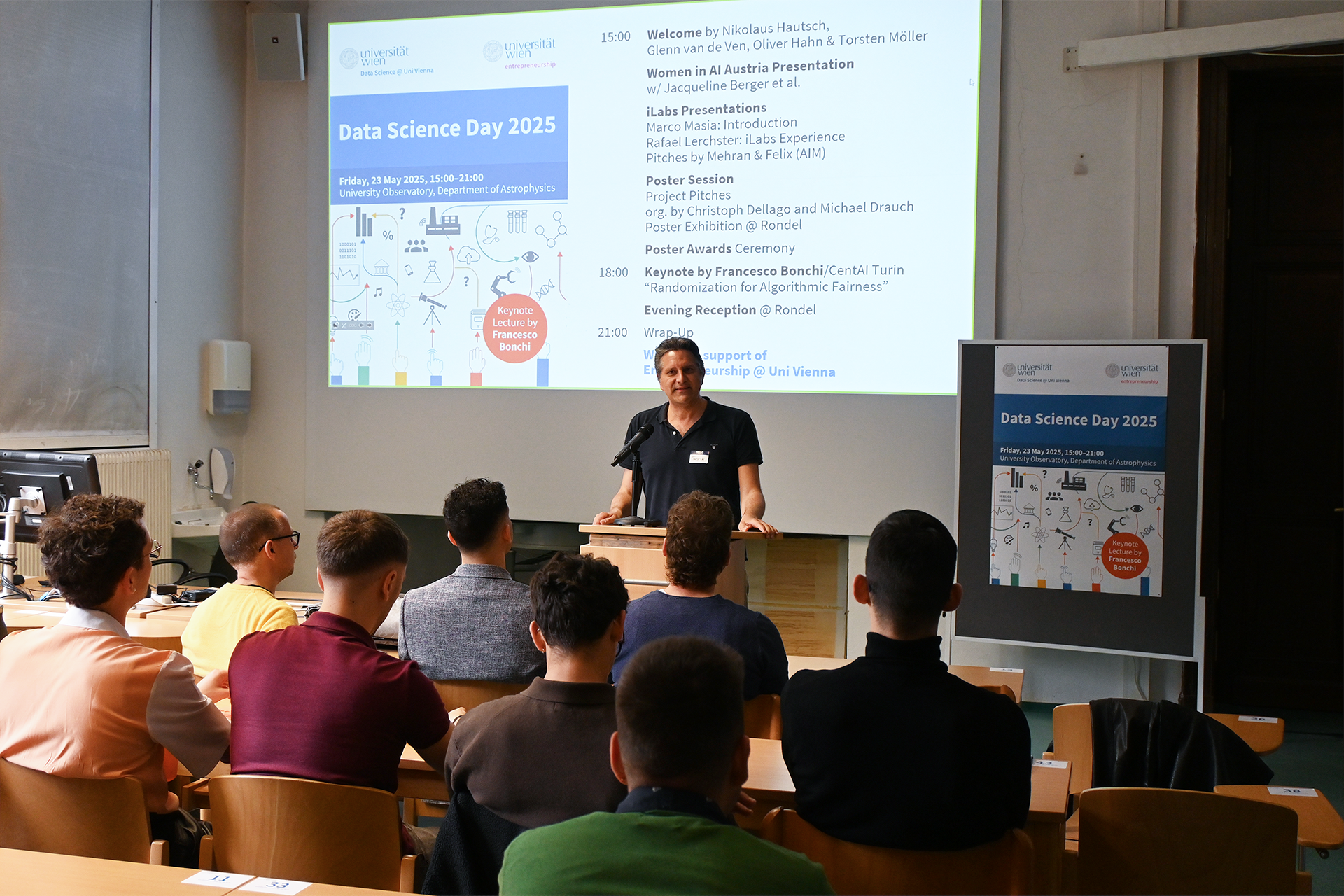
Welcome Address by the Speaker of the Research Network and Board Member Torsten Möller

Presentation of Jacqueline Berger from Women in AI Austria

Presentation of Marco Masia from Entrepreneurship @ Uni Vienna

Presentation of Hirebuddy and Digital iLabs by Rafael Lerchster

Presentation of HContextAI by Mehran Farkhondeh
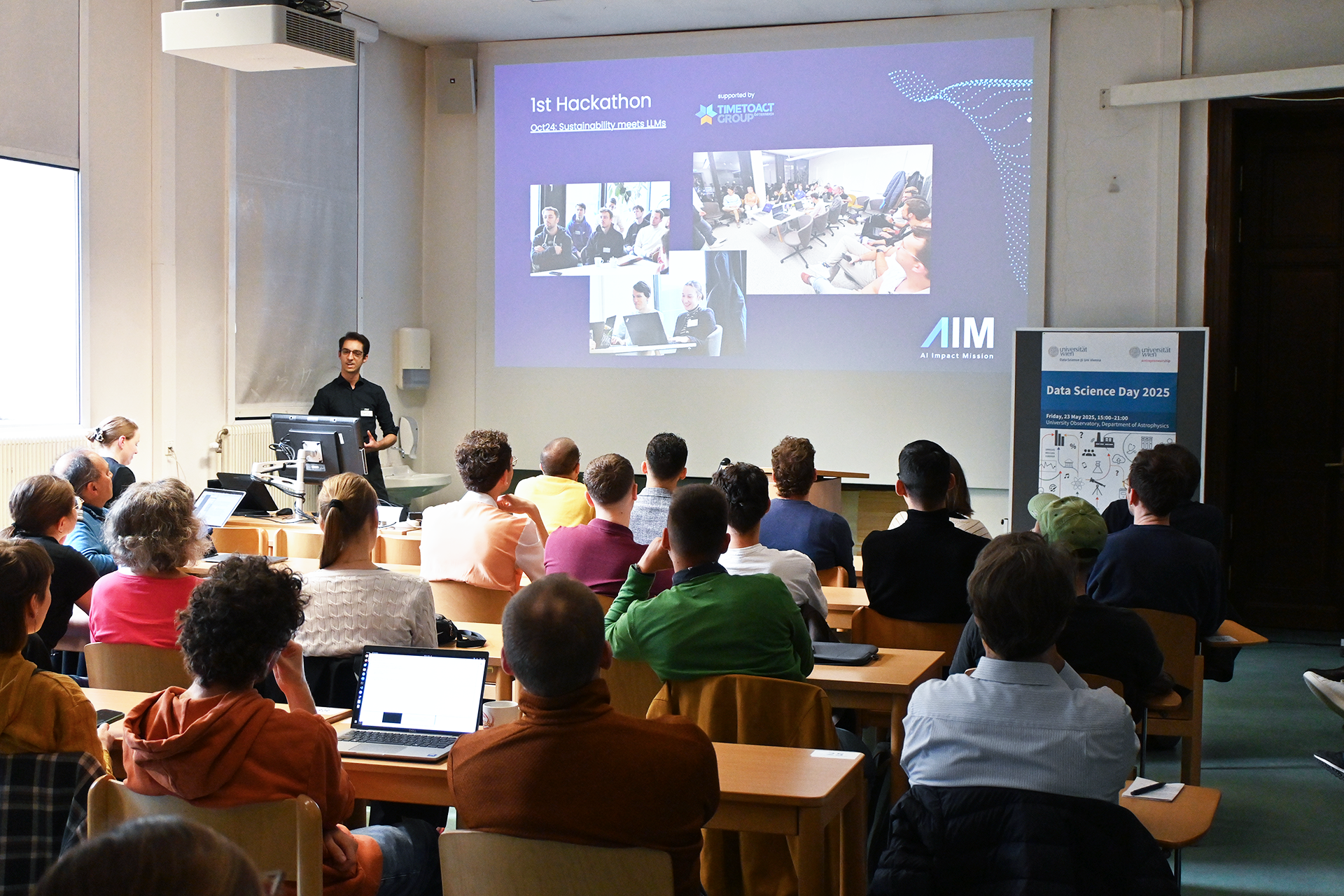
Presentation of AIM AI Impact Mission by Felix Krause
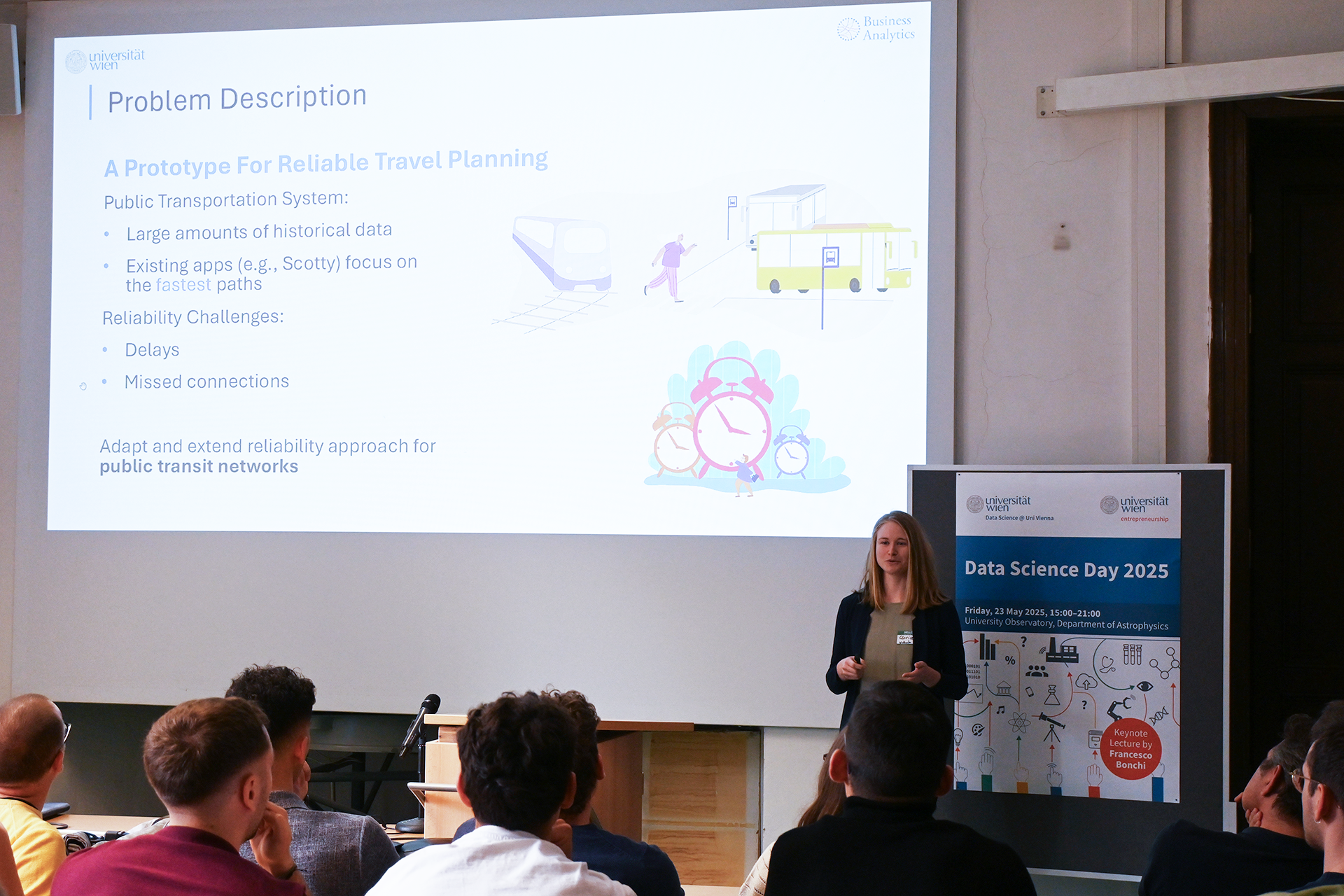
Pitch of the Project "A Prototype for Reliable Travel Planning" by Gloria Widhalm
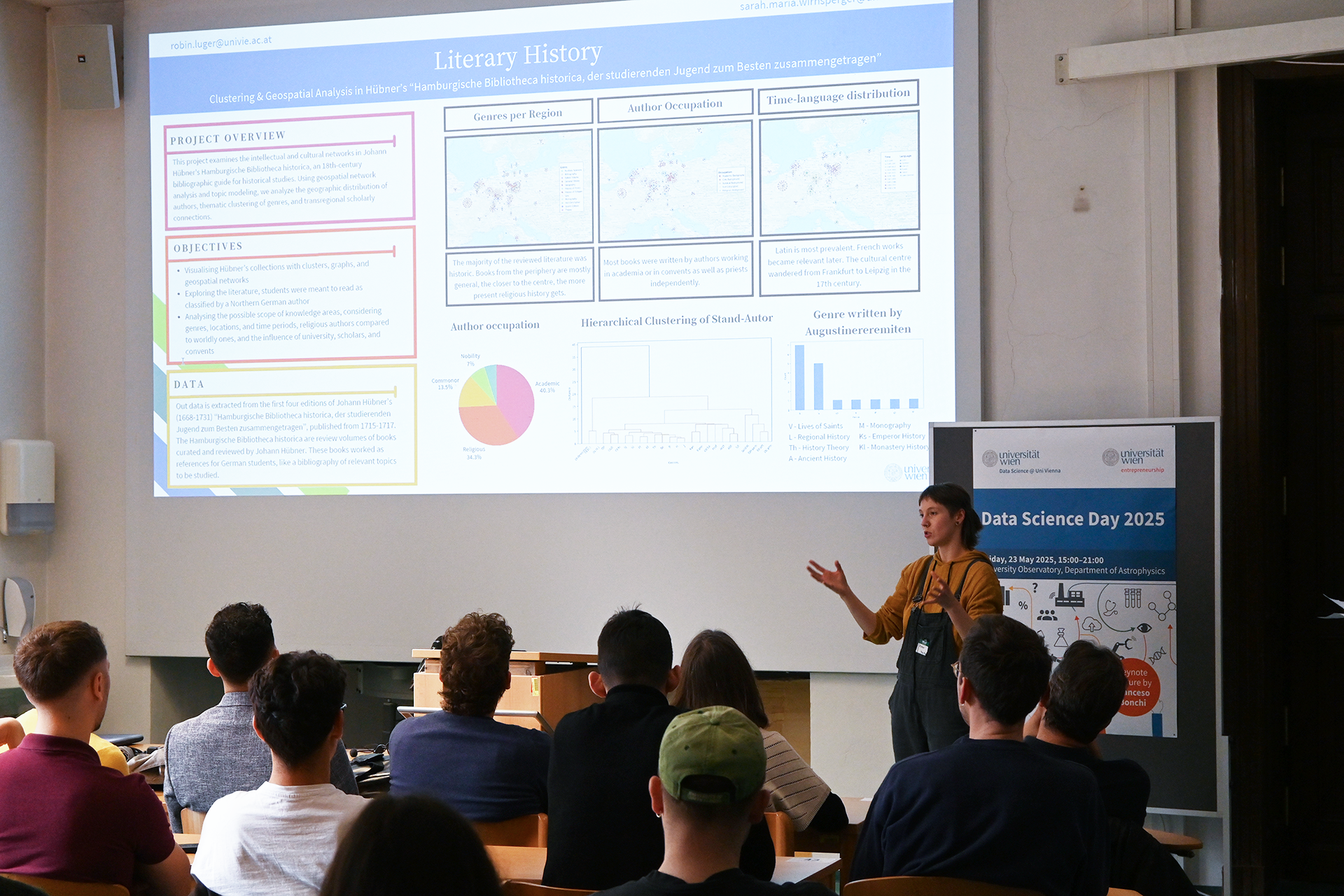
Pitch of the Project "Literary History: Clustering & Geospatial Analysis in Hübner's 'Hamburgische Bibliotheca historica, der studierenden Jugend zum Besten zusammengetragen'" by Robin Luger

Pitch of the Project "Never Stranded – Backup Travel Planning" by Paulina Heine

Pitch of the Project "Density-Based Clustering in Semi-Metric Space for Large-Scale Data" by Luiza Krzepkowska
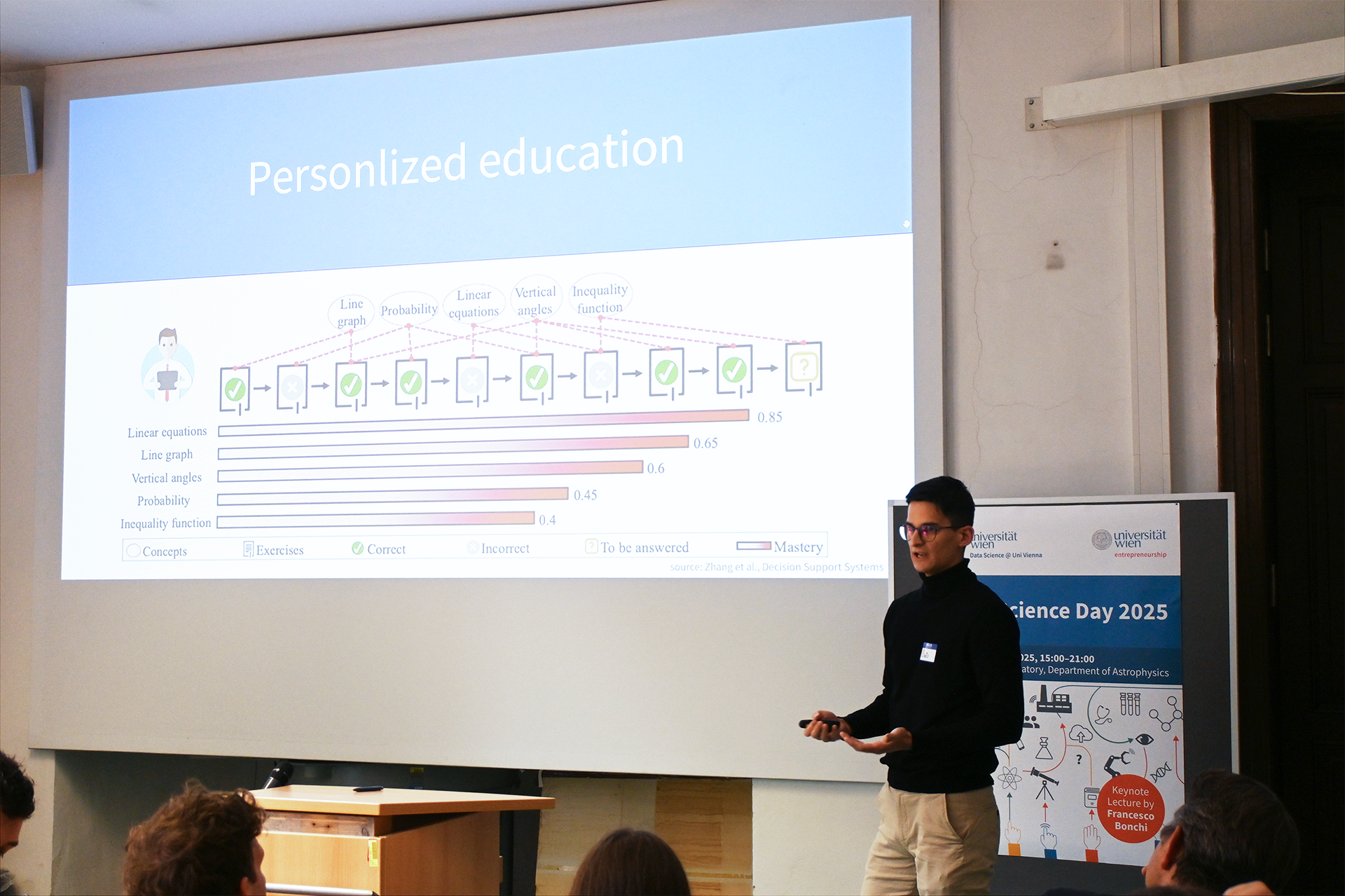
Pitch of the Project "A Deep Dive into Deep Knowledge Tracing" by Botond Kovács

Pitch of the Project "Orienteering Problem with Time Windows and Profits (OPTWP) - a Case Study for Vienna" by Christian Orlowski

Pitch of the Project "A Geospatial Analysis of Slavery: What data from the SlaveVoyages-database can tell us about the shift to the "second slavery" in the 19th century" by André Novak
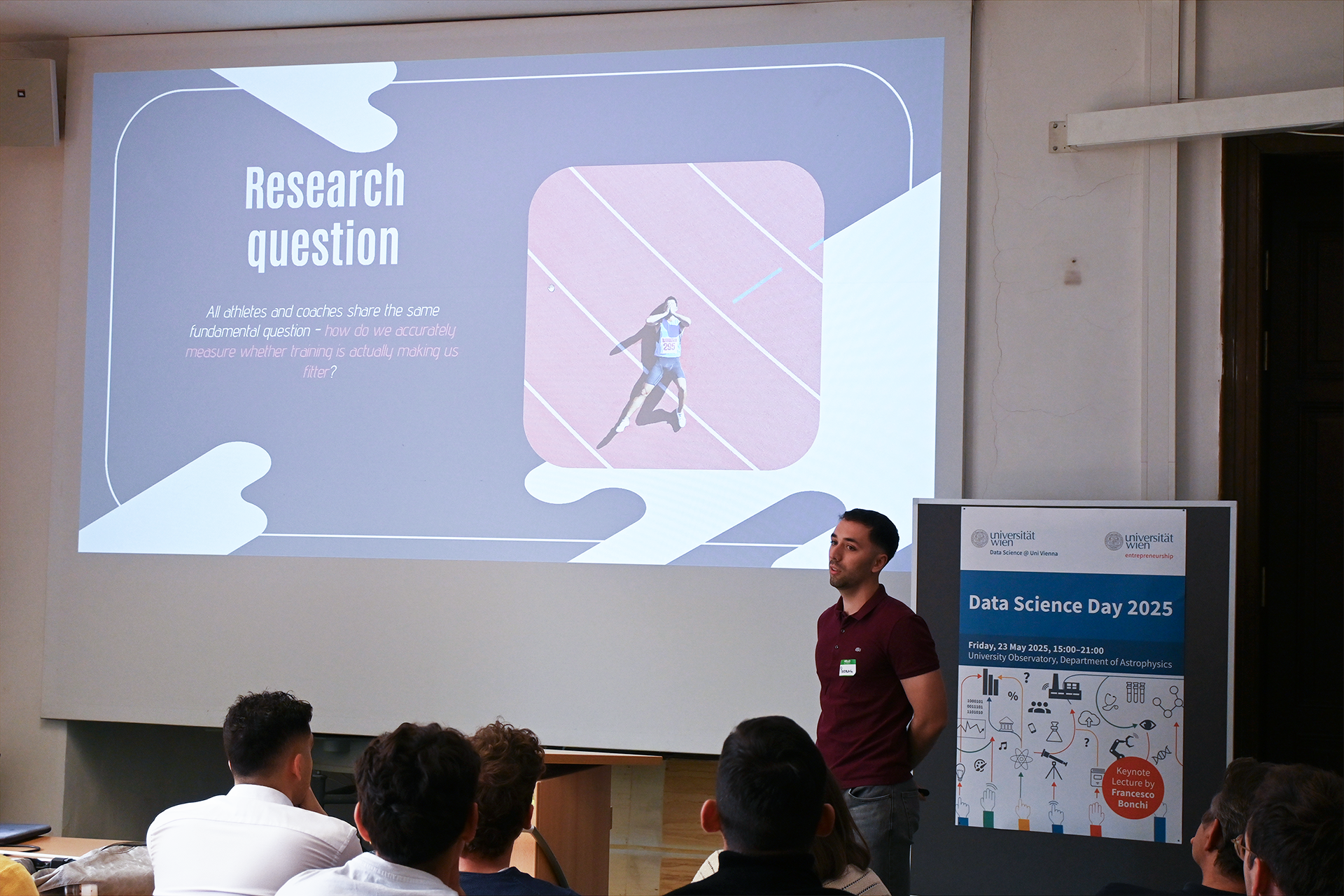
Pitch of the Project "Sportsanalytics for Rowing Data" by Predrag Dindic
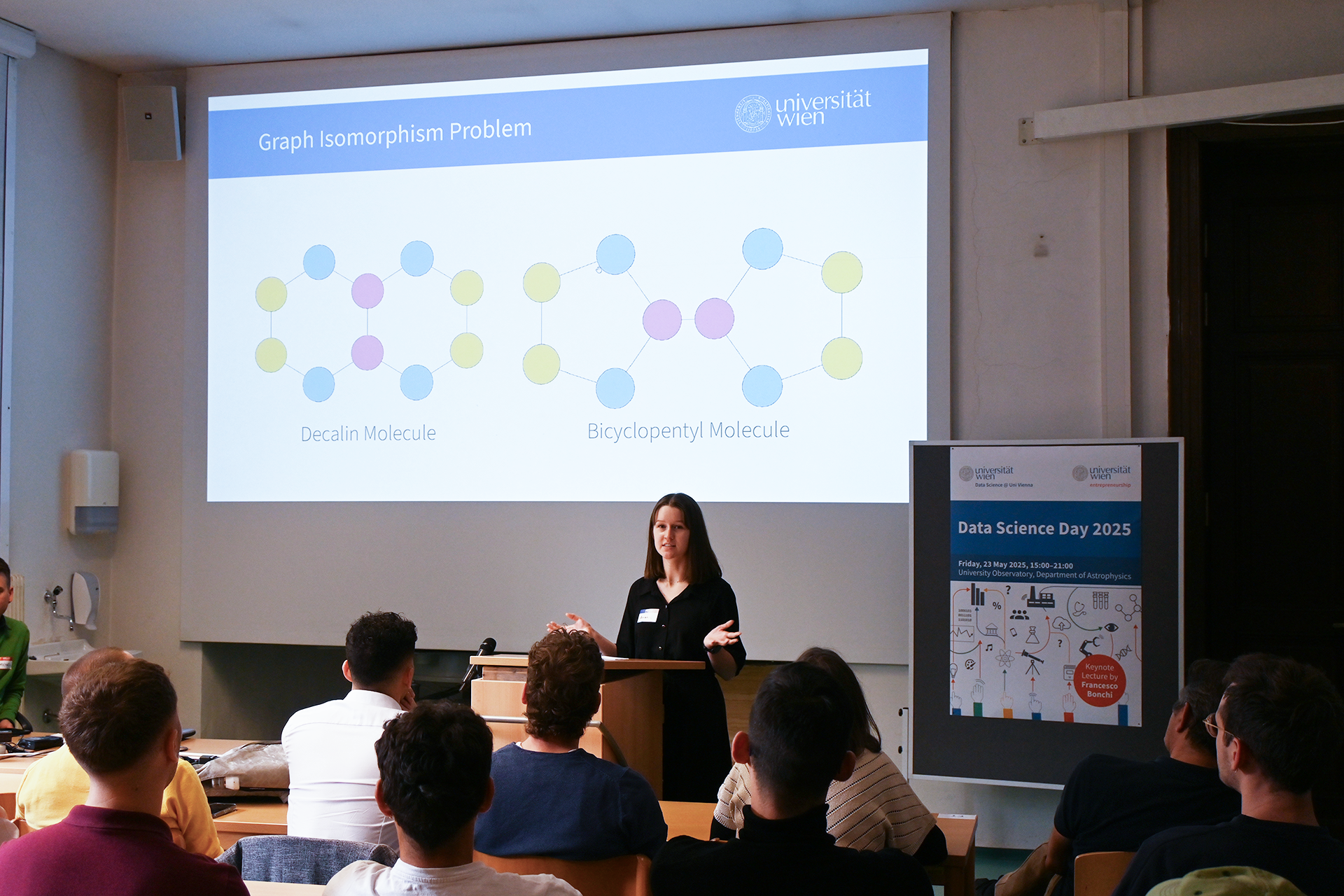
Pitch of the Project "Comparison of Graph-Encoding Trees" by Ariana Fox

Pitch of the Project "Linguistic Accommodation in Corpora and Large Language Models" by Agnieszka Gwizdek
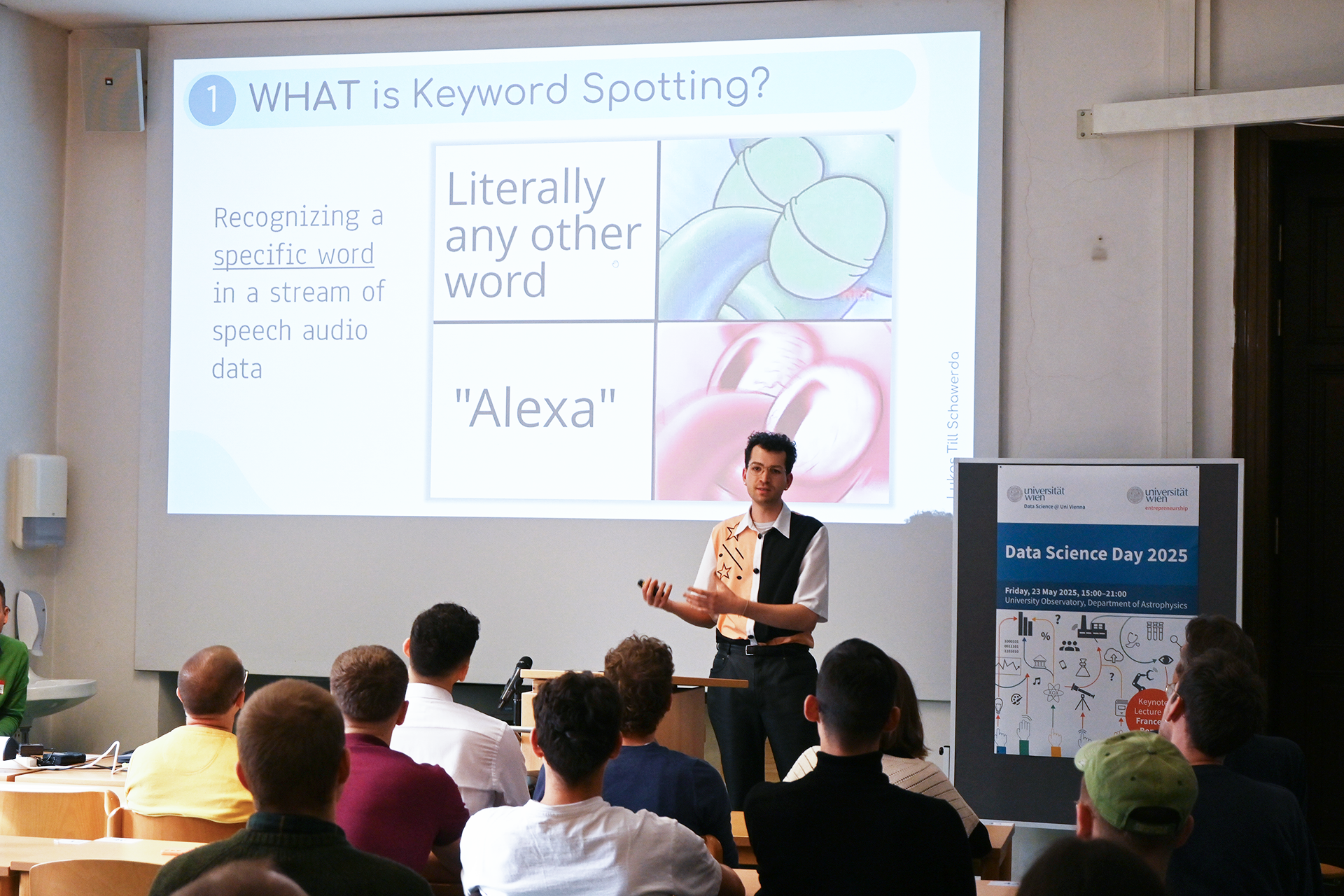
Pitch of the Project "Comparison of time-frequency representations for neural-network based keyword spotting" by Lukas Till Schawerda
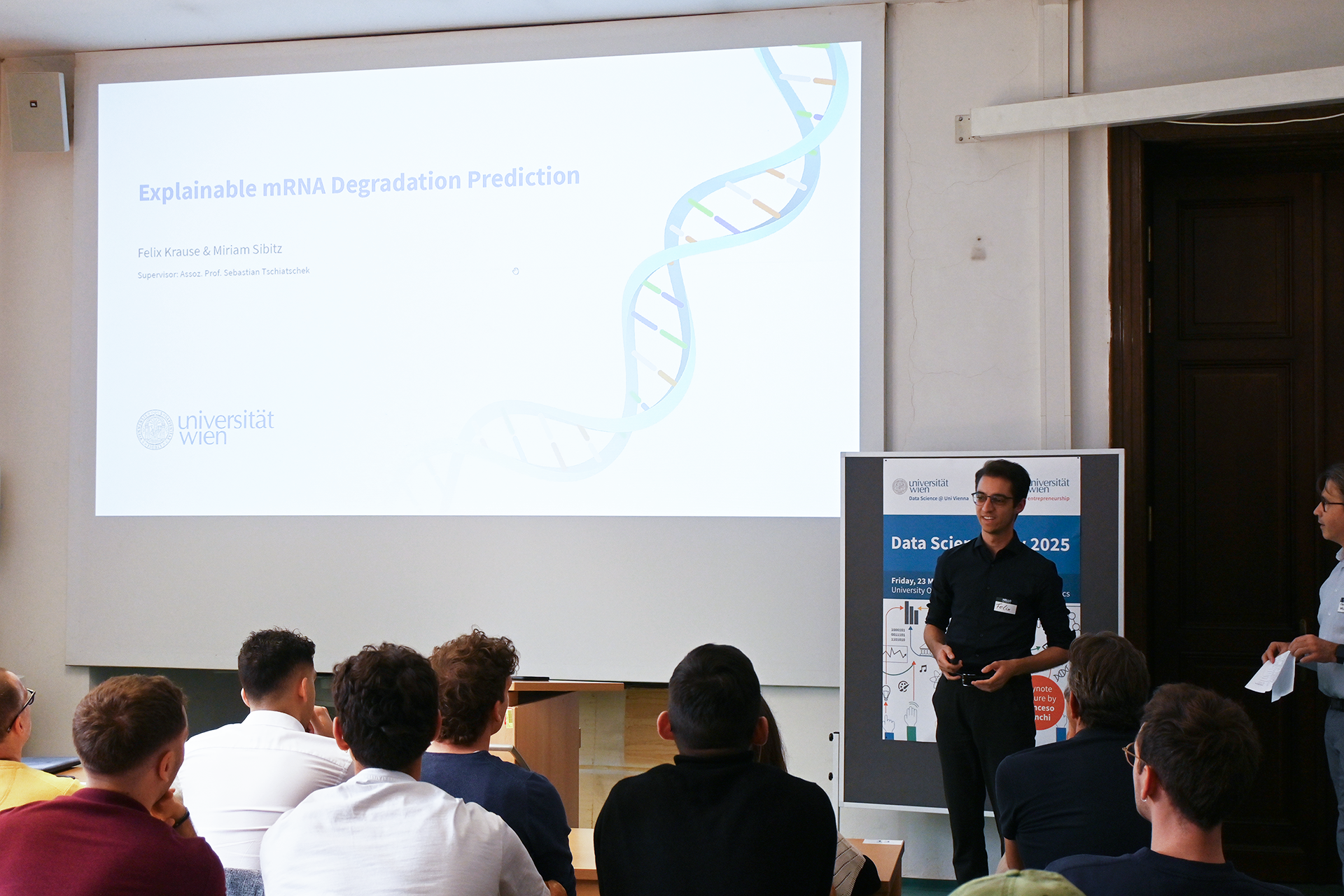
Pitch of the Project "Explainable mRNA Degradation Prediction" by Felix Krause

Pitch of the Project "Sociophonetic variation in Afrikaans vowel production" by Hannes Essfors
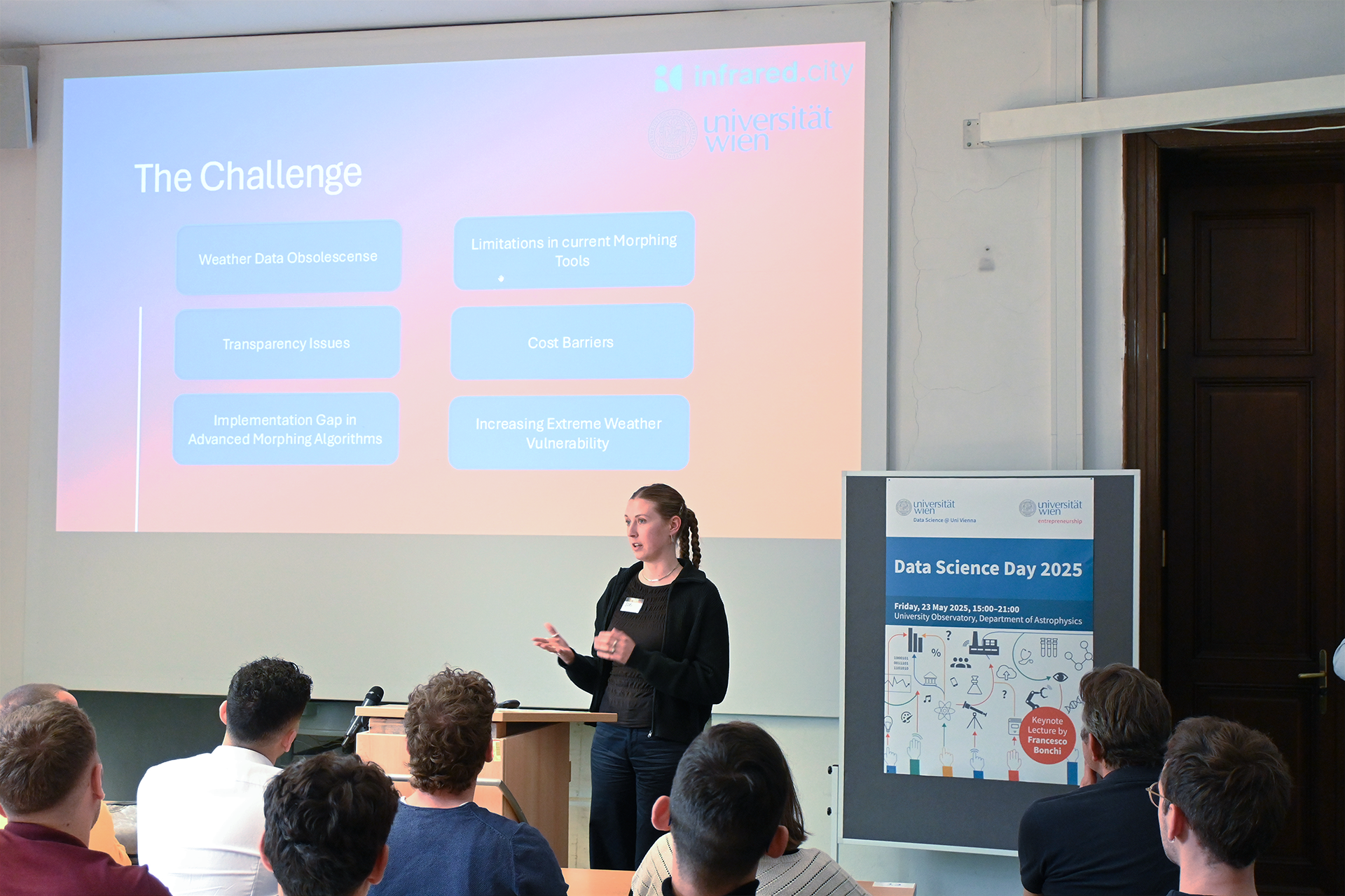
Pitch of the Project "Future Weather Data Morphing for Building Simulation" by Sophie Hamann

Gloria Widhalm and Merve Özgür
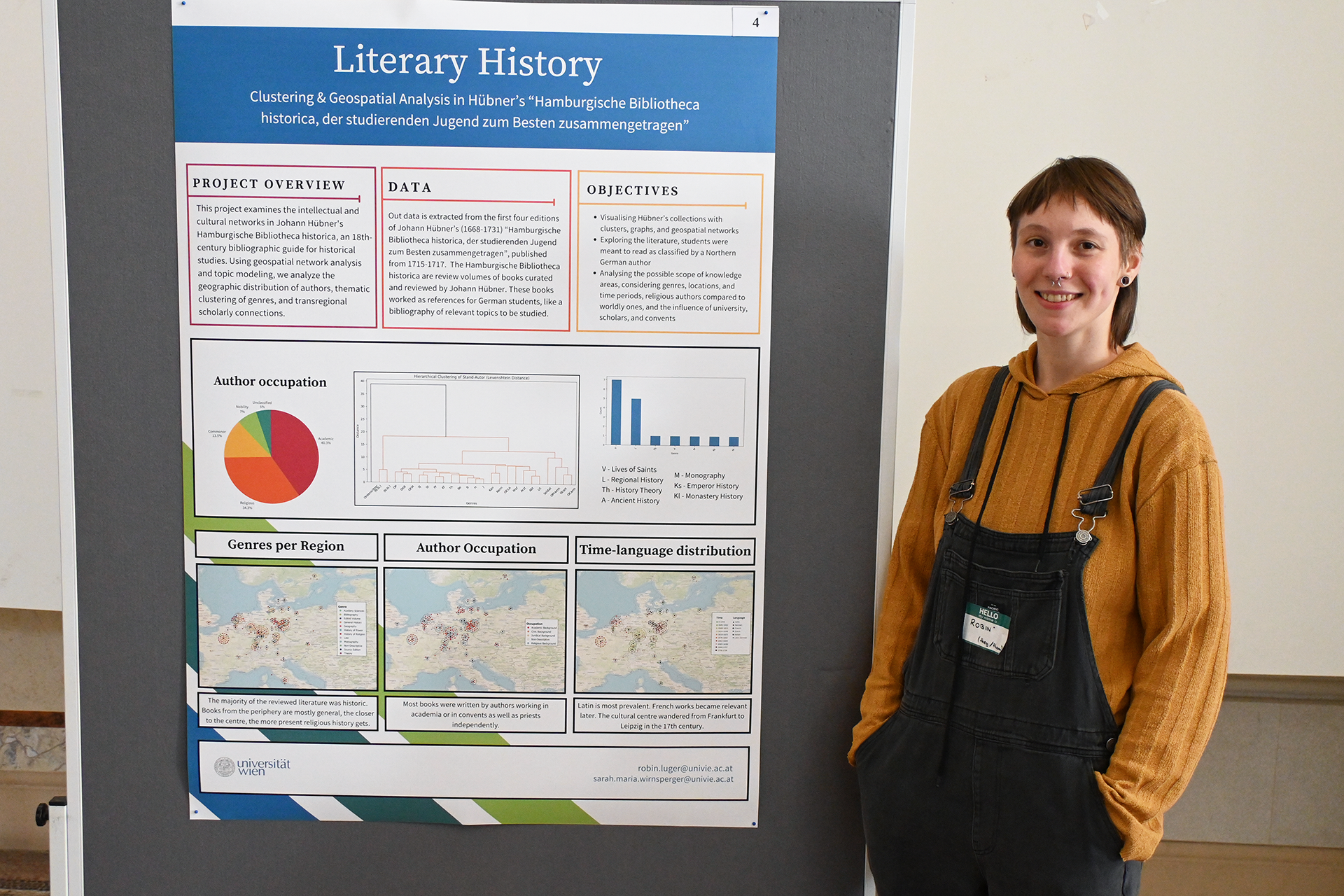
Robin Luger

Diana Lutska, Paulina Heine and Denis Vorontsov

Luiza Krzepkowska
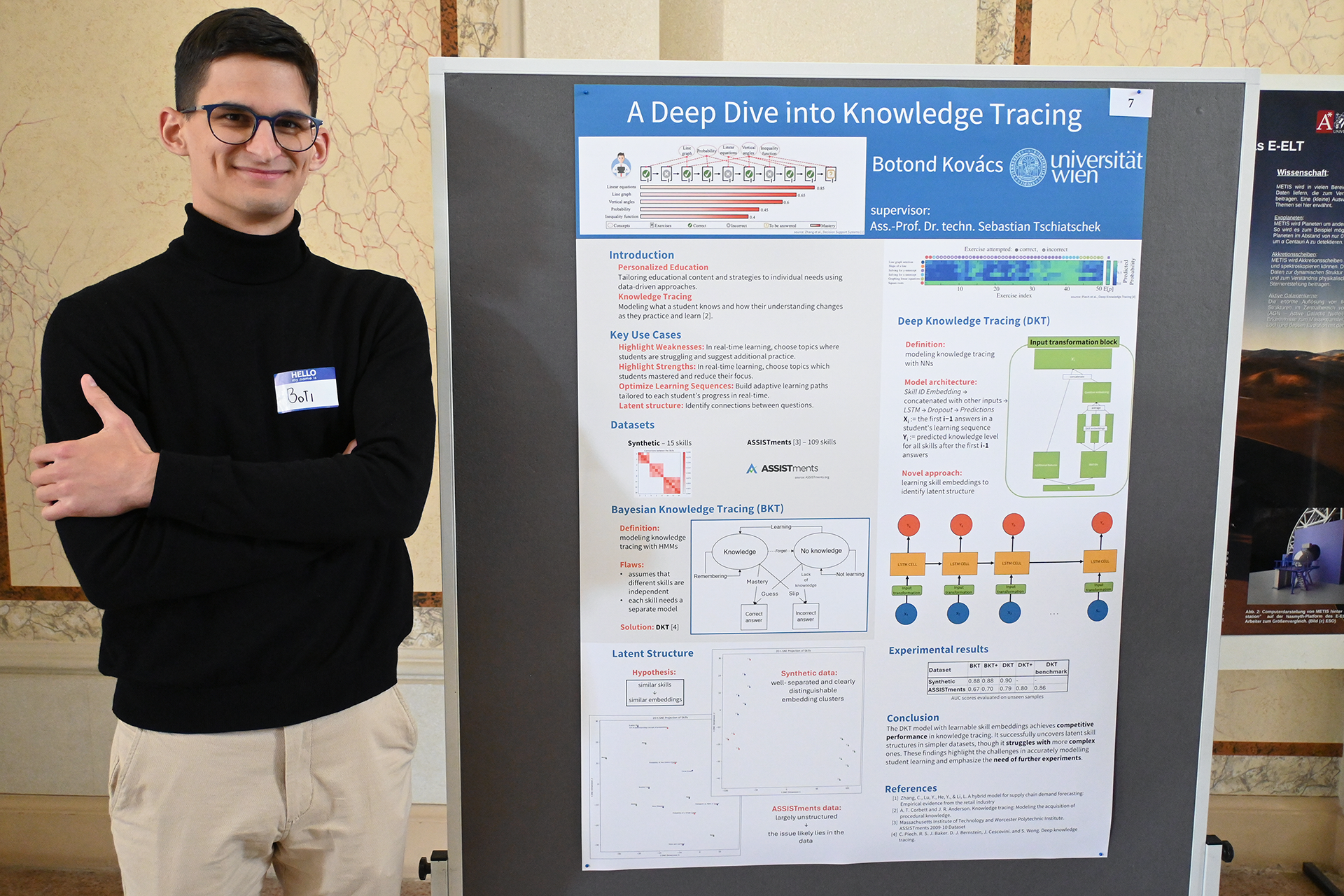
Botond Kovács
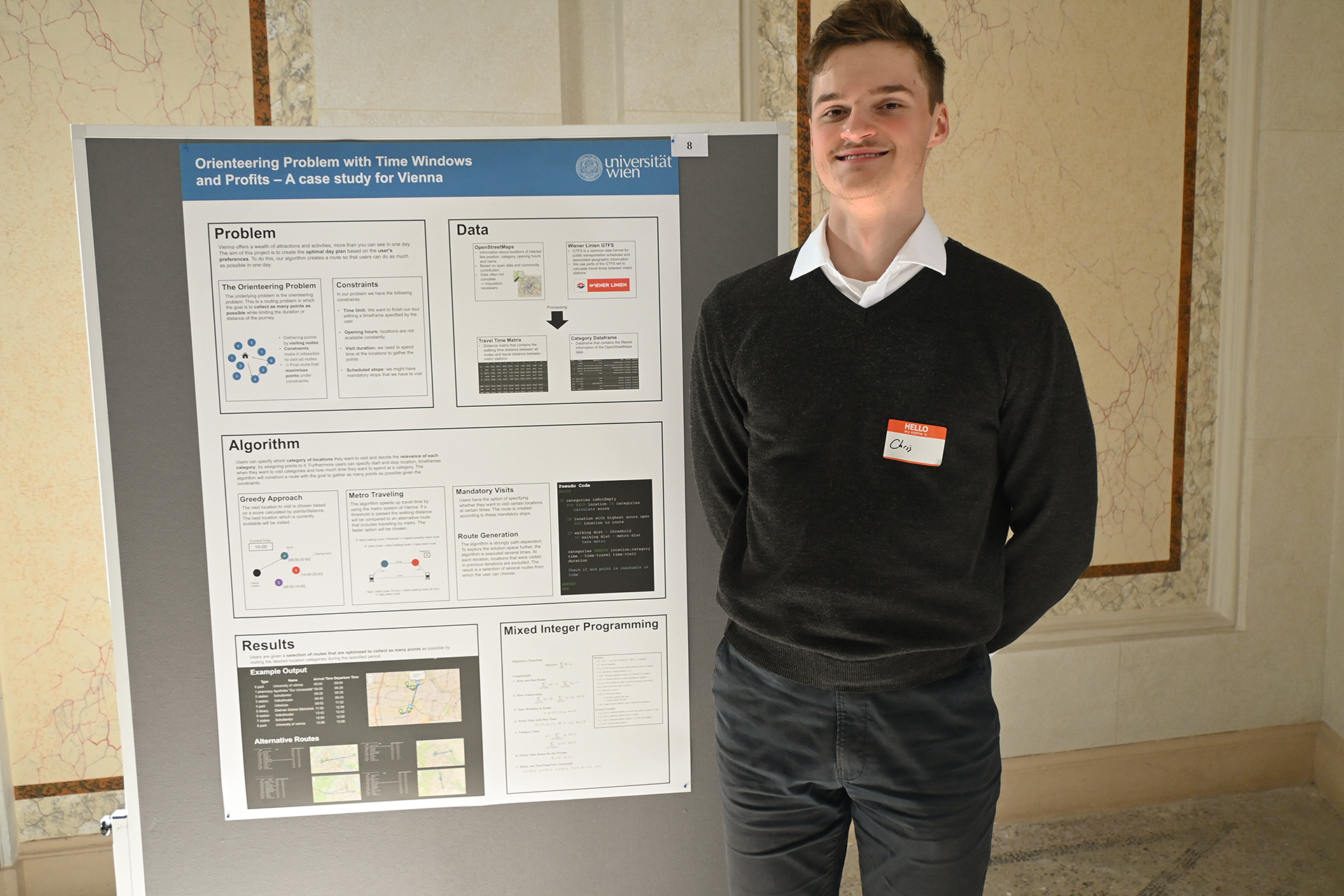
Christian Orlowski

André Novak
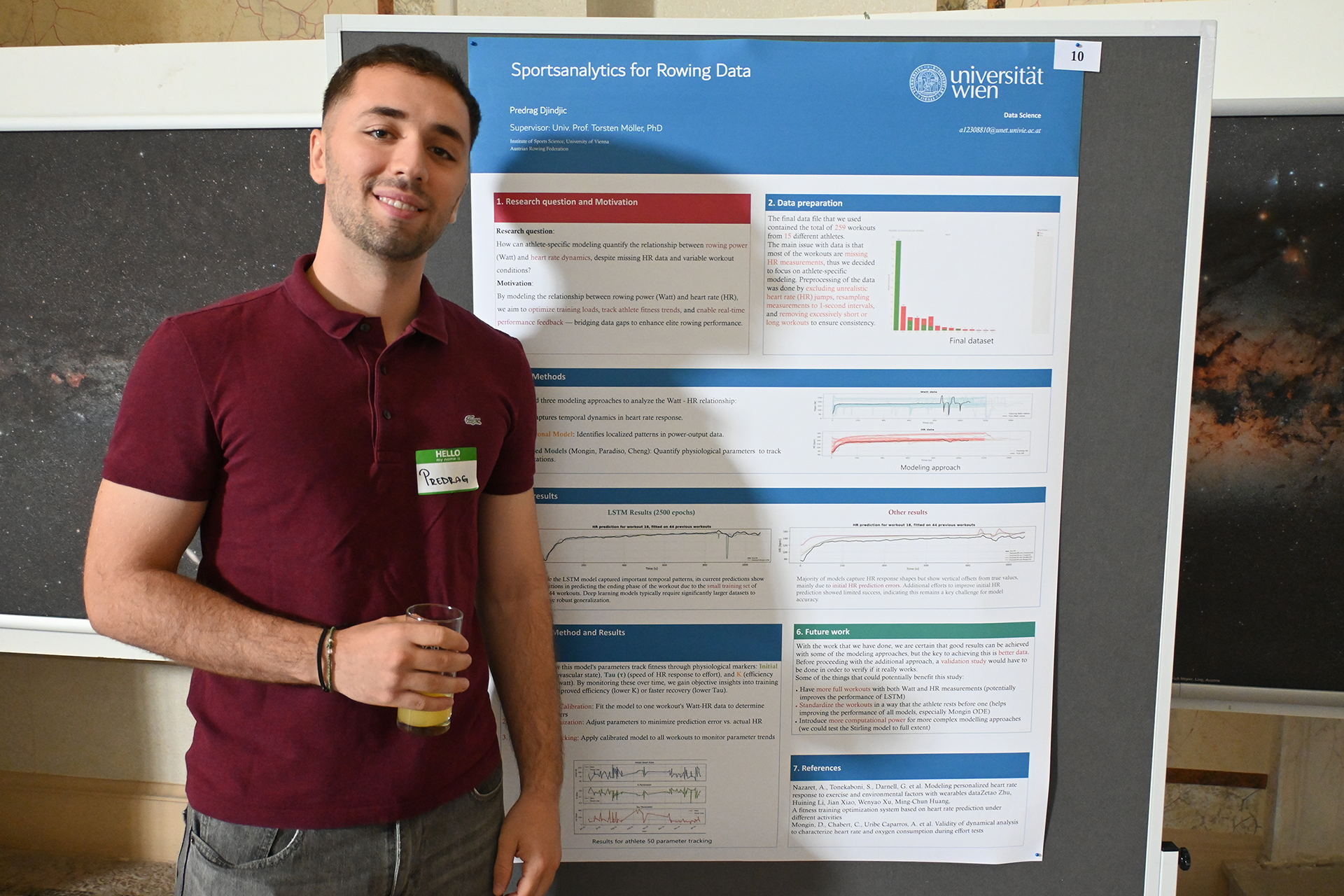
Predrag Dindic
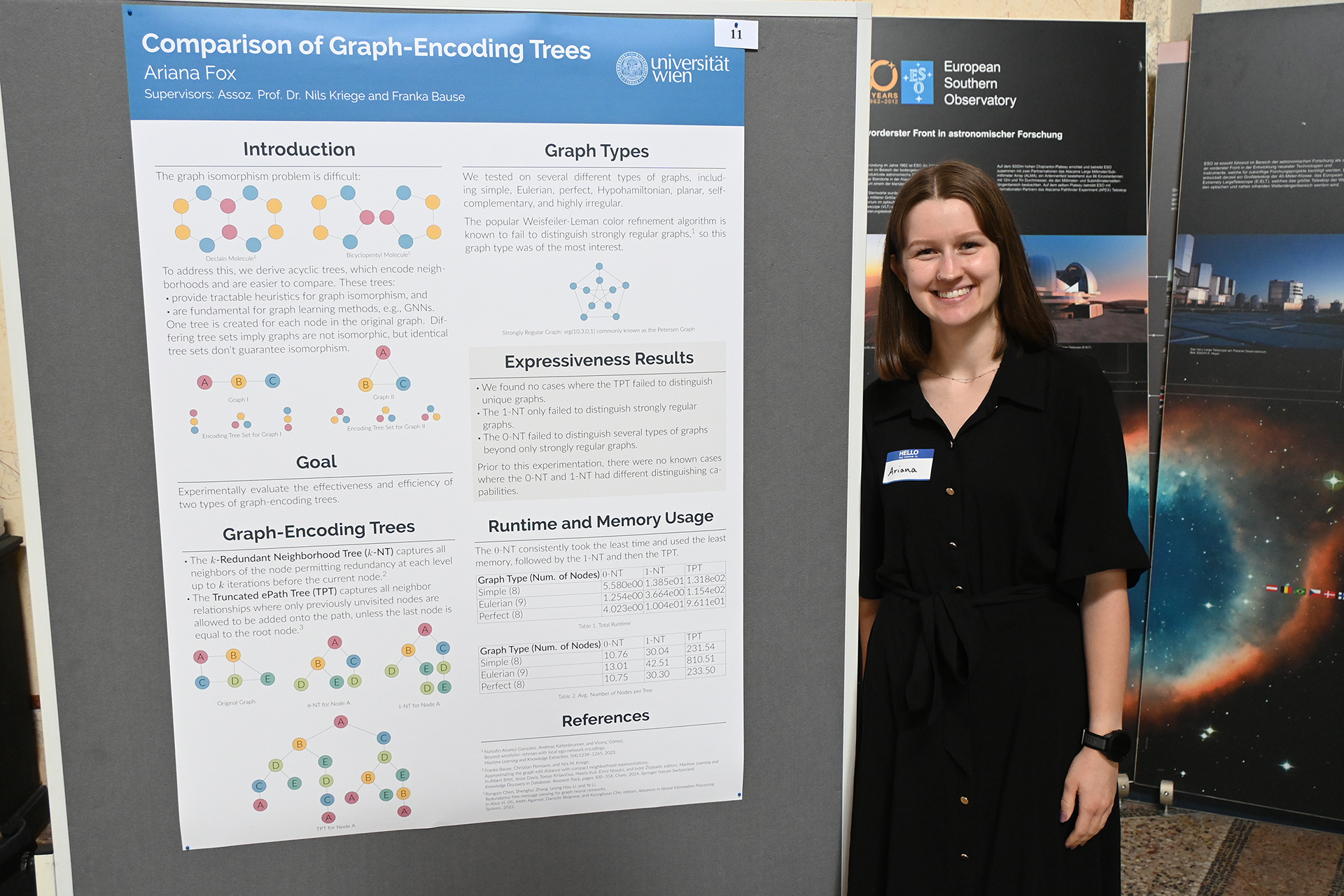
Ariana Fox

Agnieszka Gwizdek
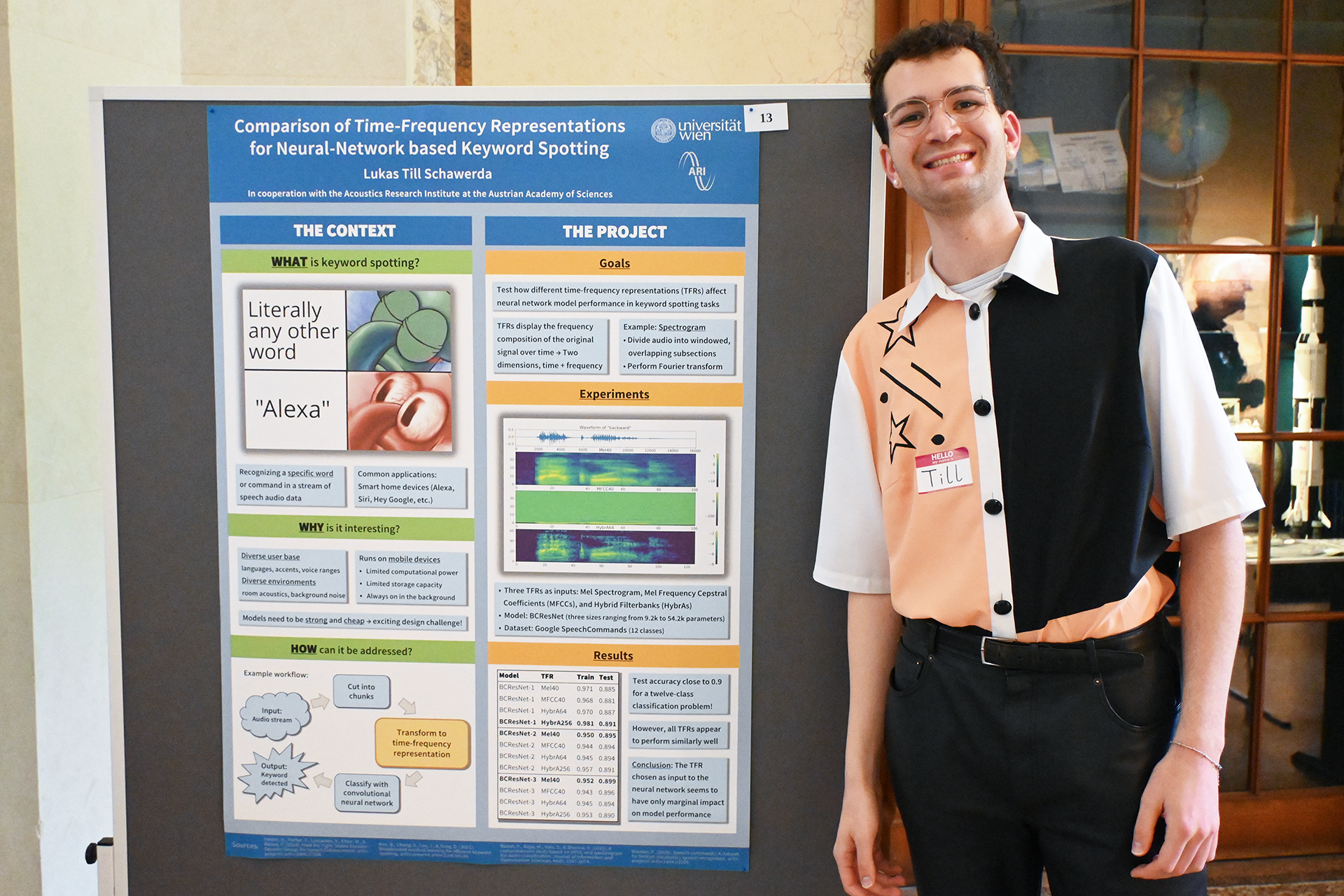
Lukas Till Schawerda
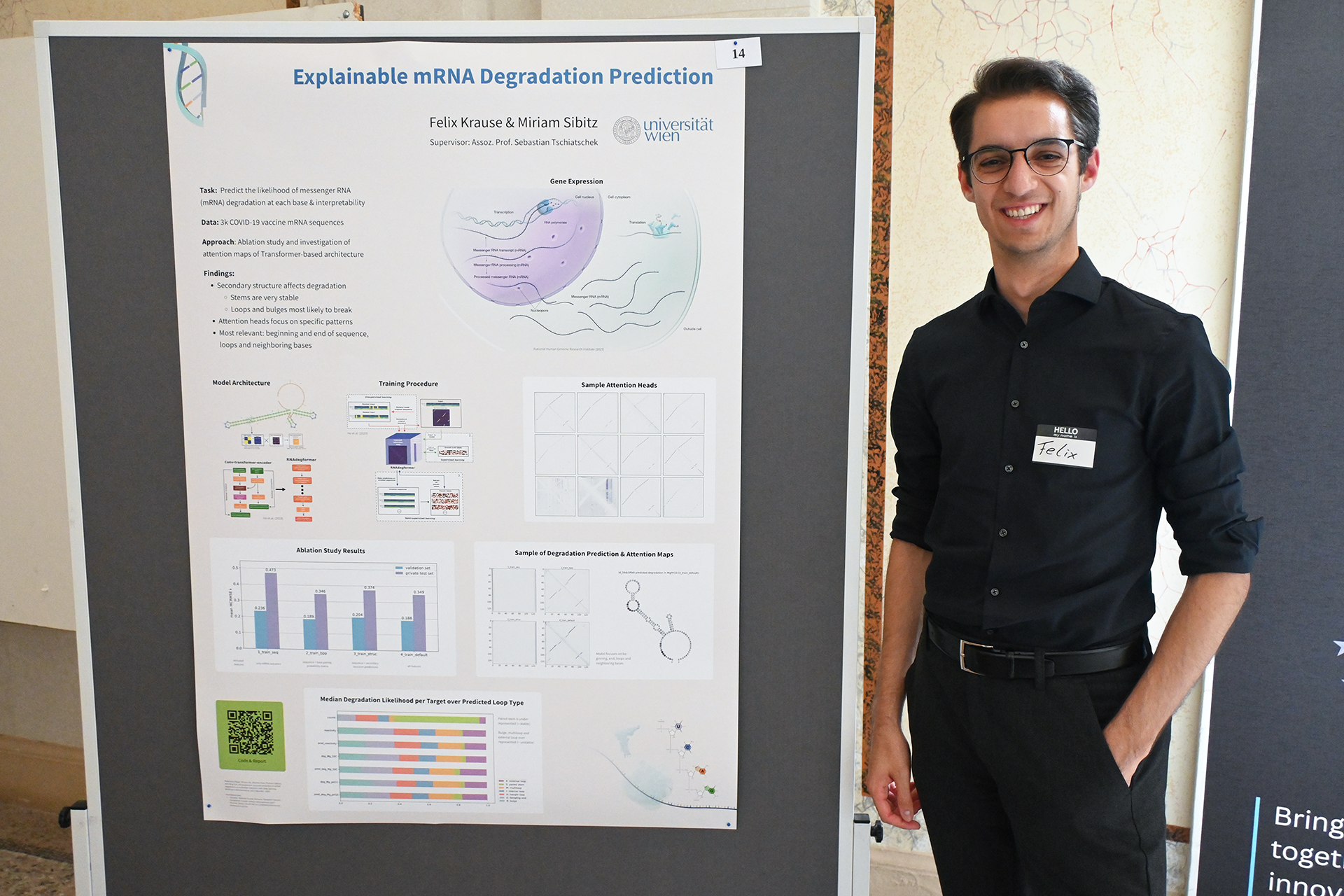
Felix Krause
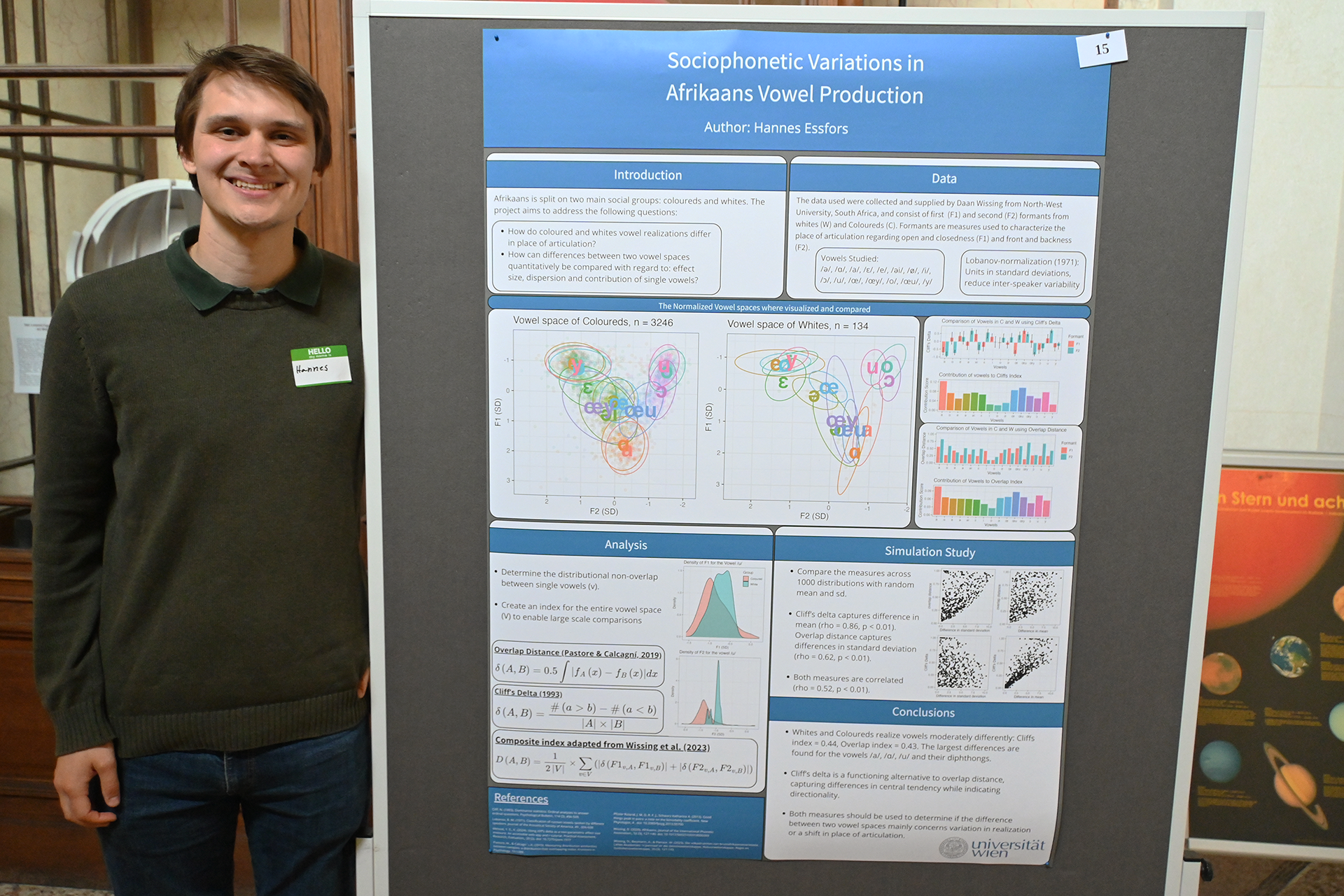
Hannes Essfors
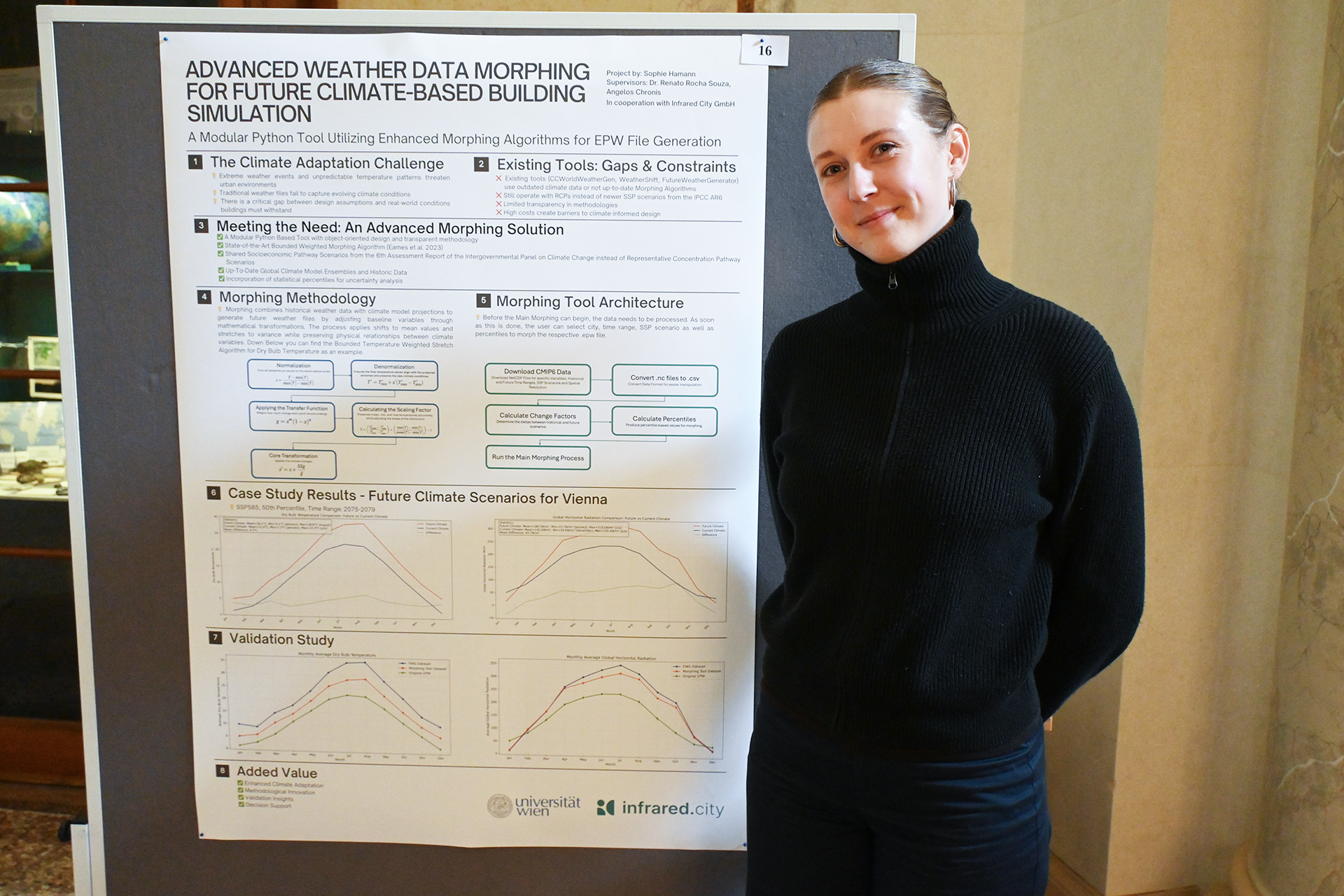
Sophie Hamann

Michael Drauch and Board Member Christoph Dellago present the Third Place Poster Award for Lukas Till Schawerda

Michael Drauch and Board Member Christoph Dellago present the Second Place Poster Award for Hannes Essfors

Michael Drauch and Board Member Christoph Dellago present the First Place Poster Award for Ariana Fox

Board Member Yllka Velaj presents the Keynote Speaker Francesco Bonchi

Keynote Lecture "Randomization for Algorithmic Fairness" by Francesco Bonchi from CentAI Turin, Italy
Photos: Petra Schönfelder
Friday 23 May 2025
15:00–18:00 Welcome & Sessions
Welcome Address
- VR Nikolaus Hautsch
- Glenn van de Ven (Head of Dept. of Astrophysics)
- Oliver Hahn (Deputy Head of Dept. of Astrophysics)
- Torsten Möller (Speaker of Data Science @ Uni Vienna)
Women in AI Austria
- Presentation by Jacquline Berger
iLabs Presentation by Entrepreneurship @ Uni Vienna
- Teams from the Innovation Labs
Poster Session
- Master students present their Data Analysis Projects
- Poster Exhibition
- Networking
Poster Award Ceremony
- Moderation Christoph Dellago and Michael Drauch
@ University Observatory
Department of Astrophysics
Türkenschanzstraße 17
1180 Vienna
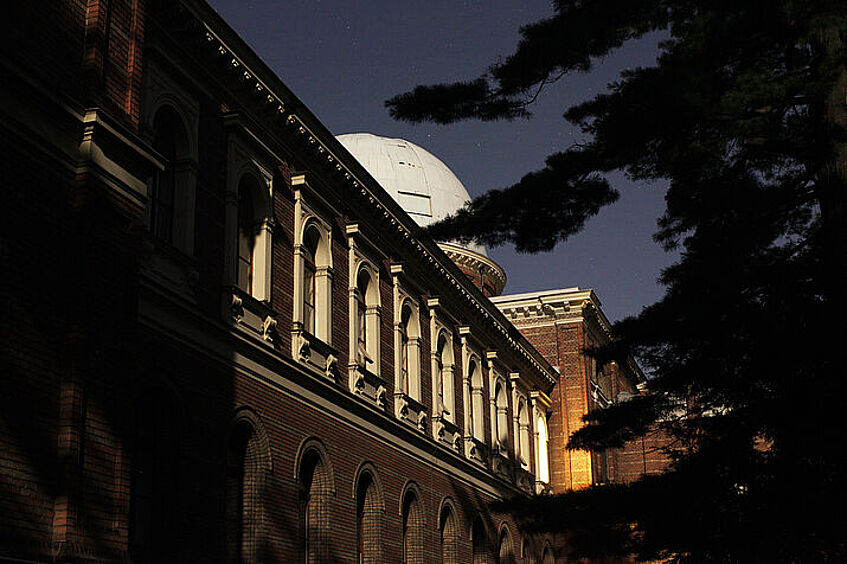
Photo: Thomas Posch
Registration is closed and the event is fully booked
18:00–21:00 Keynote & Reception
Francesco Bonchi: Randomization for Algorithmic Fairness
Abstract:
Algorithmic decision-making has become pervasive in high-stakes domains such as health, education, and employment. This widespread adoption raises crucial concerns about the fairness of the algorithms adopted. In this talk, I will delve into a recent research line that explores individual fairness in combinatorial optimization problems, where many valid solutions may exist to a given problem instance. Our proposal, named distributional max-min fairness, leverages the power of randomization to maximize the expected satisfaction of the most disadvantaged individuals. The talk will highlight applications across fundamental algorithmic challenges, including matching, ranking, and shortest-path queries.
Moderation: Yllka Velaj
followed by an Evening Reception
21:00 Wrap Up
About Francesco Bonchi
Francesco Bonchi is the Co-Founder and Research Director at CENTAI (Center for Artificial Intelligence) in Turin, Italy. He also holds a part-time position at Eurecat (Technological Center of Catalunya) in Barcelona, Spain. He also serves on the AI task-force of the Italian Government and is a member of the Board of Directors of the Anti-Financial Crime Digital Hub in Turin. Previously, he was the Scientific Director at the ISI Foundation in Turin and the Director of Research at Yahoo Labs in Barcelona.
Dr. Bonchi's recent research interests encompass algorithms and learning on complex networks, fair and explainable AI, and the broader domain of trustworthiness and ethical aspects of data science and AI. He has authored over 250 publications in these fields, earning several Best Paper Awards, including at the prestigious World Wide Web Conference 2022. Additionally, he holds 9 US patents, which earned him the 2013 Yahoo Master Inventor Award.
Dr. Bonchi has been the General Co-Chair of notable conferences such as ACM SIGKDD 2024, the 2023 European Conference on Machine Learning and Principles and Practice of Knowledge Discovery in Databases (ECML PKDD 2023), and the 5th IEEE International Conference on Data Science and Advanced Analytics (DSAA 2018). He has also been PC Chair of numerous international conferences, including The Web Conf (2026), ECML PKDD (2010 and 2018), the 16th IEEE International Conference on Data Mining (ICDM 2016), the 28th ACM Conference on Hypertext and Hypermedia (HT 2017), and the 6th IEEE International Conference on Data Science and Advanced Analytics (DSAA 2019). He is a member of the Steering Committee of ECML PKDD and IEEE DSAA, and serves on the editorial boards of several journals.
More information at: www.francescobonchi.com
About Women in AI Austria
As a local and non-profit organisation ‘Women in Artifical Intelligence Austria’, they are part of the global community of female experts and driving forces in AI and its impact on society. Their goal is to close the gender gap in the field of artificial intelligence by empowering women and raising awareness of the need for gender diversity in AI; both in the programming of algorithms and in the selection and preparation of data sets. Learn more about Women in AI Austria here: www.womeninai.at
About iLabs
The innovation labs are aimed at students, doctoral candidates, and early-stage researchers interested in learning and applying the fundamentals of entrepreneurship. Through a blend of theoretical knowledge and practical application, participants engage in an accelerated venture creation process, working to evolve their ideas from conception to pitch. Learn more about the innovation labs here: ilabs.univie.ac.at
